One of the most important things to understand when raising a Border Collie puppy is recognising the moment their brain starts connecting movement in the environment with the instinct to control it.
This does not suddenly appear as full-blown chasing, car fixation or herding behaviour.
It starts much earlier, and it often starts quietly.
For many puppies, especially those from strong working lines, this has nothing to do with fear. It is not anxiety, trauma or reactivity. It is simply instinct switching on before the puppy has the maturity, skills or emotional regulation to cope with it.
What you are seeing is the working brain waking up.
What this behaviour actually looks like
The first thing most people notice is the stare.
Not a quick look.
Not curiosity.
But a hard, fixed stare that feels almost impossible to interrupt.
You might call your puppy’s name and get no response.
You might make noises, clap, or move away.
You might offer food they would normally take without hesitation.
And suddenly, nothing works.
Their eyes are locked onto something moving. A car. A dog running. A cat. Sheep in a field. A child on a scooter. Even people jogging past.
Alongside the stare, the body starts to change.
You may notice:
- Weight shifting forward onto the front legs
- Leaning into the lead or pulling towards the trigger
- The head dropping lower
- The tail lowering or becoming very still
- A slight crouch through the body
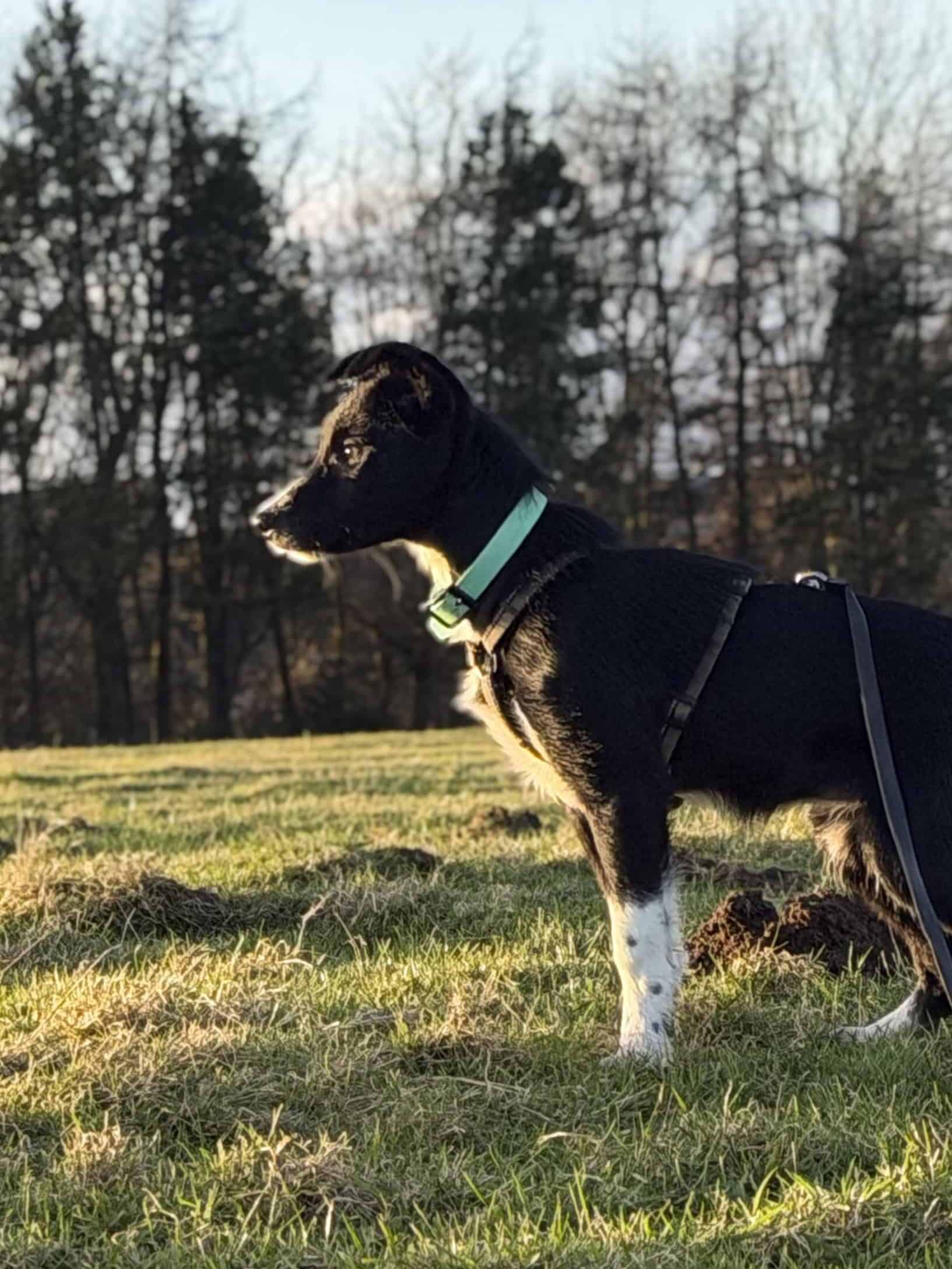
This is classic Border Collie posture.
Eye. Stalk. Control.
Your puppy is not being defiant or ignoring you on purpose. Their brain has switched into a different mode, one designed to control movement. Once they are in that state, thinking and learning stop.
These early behaviours tell you that your puppy is starting to notice movement in the world and that instinct is beginning to shape how they respond to it.
Why this can escalate so quickly
The real issue comes when these moments are rehearsed over and over again.
Every time your puppy locks on, pulls, stalks or tries to rush towards movement, their brain gets a surge of excitement and adrenaline. Even if they are on the lead and cannot reach the thing they want to control, the internal experience still happens.
That rush is powerful.
And once the working brain has felt it, it wants to repeat it.
This is why behaviours like car chasing, dog chasing or herding people can appear to come out of nowhere. In reality, the groundwork was laid weeks or months earlier during those early walks and exposures.
Rethinking walks and exposure
This is where many well-meaning owners accidentally create the beginning of their problems.
If your puppy is still very young and already showing strong interest in movement, it is important to rethink:
- How much you are walking them
- Where you are walking
- What is happening during those walks
Busy roads, traffic, runners, cyclists, dogs playing and unpredictable environments are often far too stimulating for a young Border Collie brain.
Your puppy is not learning to ignore them.
Your puppy is learning to practise controlling them.
If every walk involves repeated staring, pulling, freezing or frustration at the end of the lead, that walk is not helping your puppy. It is strengthening the behaviour you will later try to undo.
Sometimes the best decision is less walking, not more.
That might mean:
- Shorter, calmer outings
- Avoiding traffic-heavy areas
- Choosing environments with minimal movement
- Delaying “normal walks” until your puppy has more skills
If your puppy is very young, structured lead walks are not essential. What matters far more is the quality of the experience, not the distance covered.
Finding better ways to meet your puppy’s needs
Your puppy still needs movement, exploration and freedom, but it needs to happen in a way that does not constantly trigger the herding brain.
That might look like:
- Safe, enclosed spaces
- Quiet fields or private land
- Controlled environments with predictable movement
- Opportunities to sniff, explore and move without pressure
Freedom without emotional safety often creates problems.
Freedom built on the right foundations creates stability.
The importance of foundation work at home
What you do at home is just as important as what you do outside.
At home, your puppy should be learning:
- That paying attention to you is valuable
- That responding to their name matters
- That disengaging is reinforcing
- That their instinct can be channelled into games, food, toys and interaction with you
This is the foundation of my puppy training.
We do not suppress instinct.
We do not punish focus away from you.
We teach the puppy where to put that focus.
When a puppy has strong engagement, good response skills and a long history of choosing you, they are far better equipped to cope with movement in the outside world.
If you are seeing this in your puppy
If you are noticing these early signs in your Border Collie puppy, do not panic.
But do not ignore them either.
Early awareness and small changes now can prevent a lot of frustration later. This is exactly why I talk so much about foundations, engagement and thinking before exposure.
If you would like help building the right foundations for your puppy, or you are unsure whether what you are seeing is instinct starting to switch on, you can book a session with me.
Together we can look at your puppy, your environment and your current routine, and put a clear plan in place before these behaviours become habits.
👉 Book a puppy training session here
Early guidance makes all the difference for a Border Collie brain.