
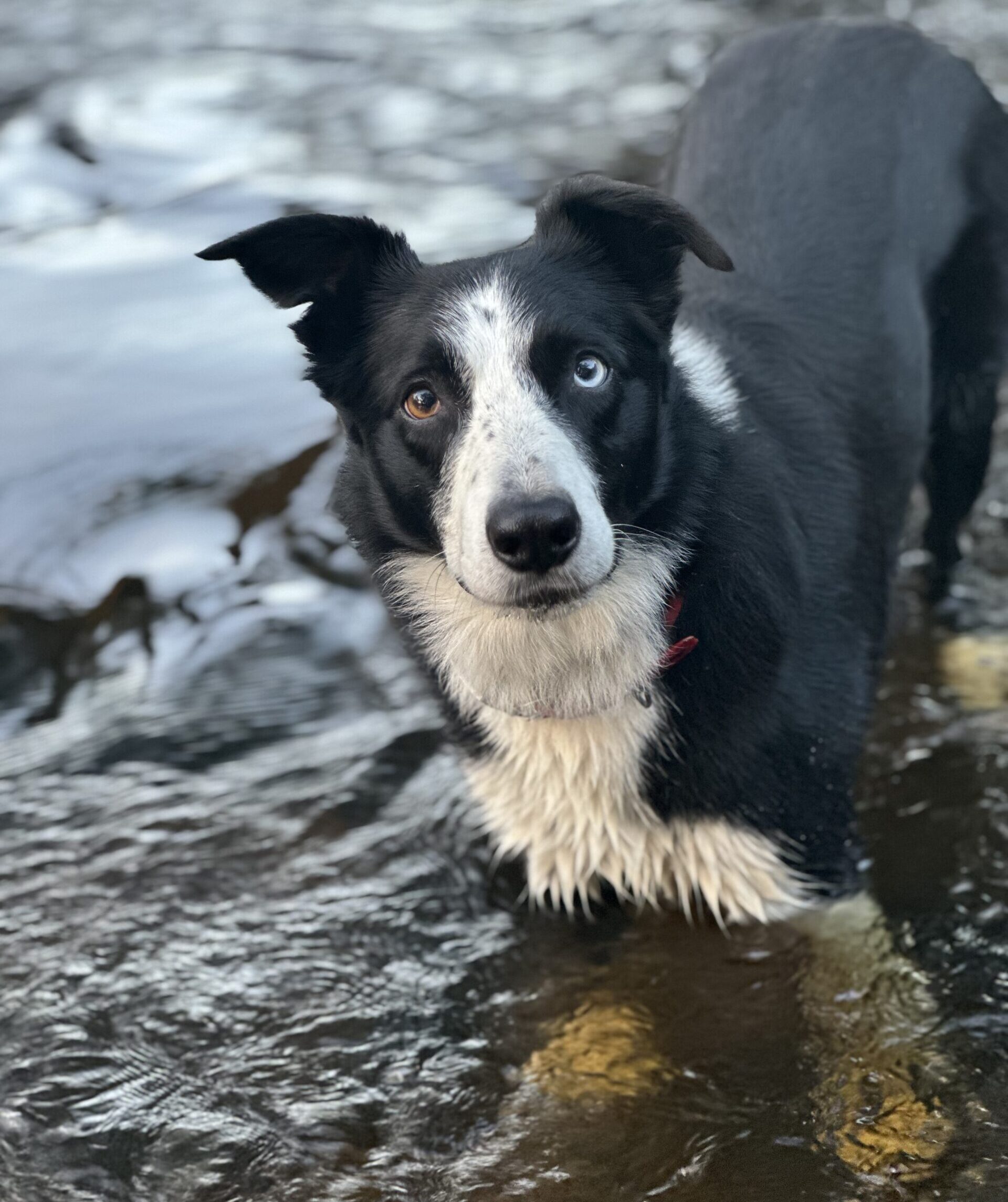
Car chasing is one of the most common behavioural concerns owners experience with Border Collies.
It is also one of the most misunderstood.
Many people assume that when a Border Collie chases cars it must be because the dog lacks an outlet for its herding instincts. The common belief is that if the dog is given the opportunity to herd something else — sheep, toys, bikes, or even other dogs — the behaviour will disappear.
But in reality, Border Collie car chasing is often a conditioned response, not simply a lack of herding opportunities.
Recently I worked through a training session with a young Border Collie named Bran that illustrates this perfectly.
A Real Training Example: Working Through Car Chasing
Bran is a young Border Collie who recently came back to live with me. Over the last few weeks he has settled into life here very easily.
He is friendly with other dogs, enjoys training sessions, loves to play, and settles calmly both in his crate and kennel. He has also shown interest in sheep and works nicely when given the opportunity.
In many ways he is exactly what you would expect from a young Border Collie: energetic, curious, and enthusiastic about the world.
But one behaviour that had been reported was car stalking and potential car chasing.
To start working on this, I took Bran to a garden centre car park for a controlled exposure session.
Rather than immediately walking into a busy environment, I parked as far away from the activity as possible and started working with him there.
Before moving closer to cars and people, I first checked a few important things:
- Could he take food?
- Could he follow food?
- Could he engage with me?
- Could he disengage from surrounding noises?
These are critical pieces when working through Border Collie reactivity or environmental sensitivity.
Once Bran showed he could stay engaged, we slowly moved closer to the busier part of the car park where cars and people were moving around.
At first there was some tension in his body and a bit of shaking. The train line runs right next to the garden centre, so when a train arrived there were extra noises to process.
But very quickly he settled into the environment and into the training.
Bran is extremely food motivated and eager to work, which makes these situations easier to manage.
Why Border Collies Chase Cars
During the session Bran showed a couple of moments where he wanted to drop into a stalking posture when cars passed.
However, the behaviour was easily redirected.
Instead of allowing him to stop and stare at the cars, I kept him moving and engaged with me so that the passing vehicles became part of a positive training session rather than something to fixate on.
And this is where we need to address a common misconception about Border Collie behaviour.
Car chasing in Border Collies is very often explained as a lack of herding outlets.
The assumption is that if the dog is allowed to herd sheep, chase a ball, or perform other herding-style behaviours, the car chasing will stop.
But Bran clearly shows that this explanation is incomplete.
He lives on a farm.
He has outlets.
He has access to sheep.
And yet the response to moving cars was still present.
This suggests that what we are seeing is a conditioned response, likely created by a moment of fear, frustration, or excitement that became reinforced over time.
Once a behaviour like that becomes conditioned, it does not disappear simply because the dog now has appropriate outlets.
It needs to be actively retrained.
Meeting a Border Collie’s Needs Still Matters
Now, this does not mean that meeting a Border Collie’s needs is irrelevant.
In fact, it is extremely important.
A dog whose physical, mental, and behavioural needs are not met will often struggle to learn and regulate emotions.
But meeting those needs alone does not automatically solve behaviours like:
- car chasing
- bike chasing
- reactivity to movement
- environmental sensitivity
What it does do is place the dog in a better emotional state so that training can actually work.
In Bran’s case, the fact that he has outlets, training opportunities, and a stable environment means we can now work through the conditioned response effectively.
Training Border Collies Through Behaviour Problems
One of the most important things to understand about Border Collies is that their intelligence and sensitivity can make them both incredibly trainable and highly reactive.
Behaviours like car chasing are rarely solved by:
- simply giving the dog more exercise
- letting the dog herd something else
- hoping the behaviour disappears with age
Instead, they require:
- structured exposure
- engagement with the handler
- clear reinforcement strategies
- careful reading of the dog’s emotional state
This is exactly the kind of work I demonstrate in the training session linked below.
In the video you’ll see how I approach this type of situation step by step.
The first priority is making sure Bran can cope with the environment from a distance before asking anything more from him. Rather than walking straight into the busiest part of the car park, we start far enough away that he can still think, take food, and stay engaged with me.
From there I work a lot with a variation of the “look at that” game. This allows him to notice what is happening around him — people moving, cars driving past — while also learning to disengage from the environment and reconnect with me. The environment becomes something he can observe calmly rather than something he needs to react to.
Sometimes you will see me call his name and reward him for disengaging when I feel he is becoming too focused on something. But just as important is waiting for him to choose to disengage on his own. When he looks at something and then looks back to me voluntarily, that decision gets reinforced.
You’ll also notice that we are rarely standing still.
Keeping him moving helps prevent him from locking into the stalking posture. I use a lot of luring to guide his movement, changing direction frequently and sometimes walking backwards so he naturally follows and re-engages with me. This allows him to move away from things with me rather than feeling like he is being dragged away from something he wants to focus on.
Another important part of this work is social support. It’s not just about food rewards. I make sure he knows I’m present, engaged, and supporting him through the situation so that the environment becomes easier to navigate.
Some parts of the video are slightly sped up — otherwise the session would have been very long — but you can still see the structure of the work: the markers, the reinforcement, the movement, and the gradual progression through the environment.
Enjoy the video.
Watch a real life training session with Bran
Want to Learn How to Train Your Border Collie Like This?
If you live with a high-energy or reactive Border Collie and want to learn how to guide them through challenges like this, that’s exactly what we work on inside The Collie Club.
The Collie Club is my online training academy designed specifically for Border Collie owners who want to transform their dog into a focused, responsive partner.
Inside the club we work on:
- engagement and focus
- managing reactivity
- impulse control
- play and reward systems
- building reliable behaviours
- channeling the Border Collie brain productively
Instead of quick fixes, you learn the training systems and principles that allow you to understand and guide your dog.
If you’d like to learn more, you can explore the Collie Club here: